

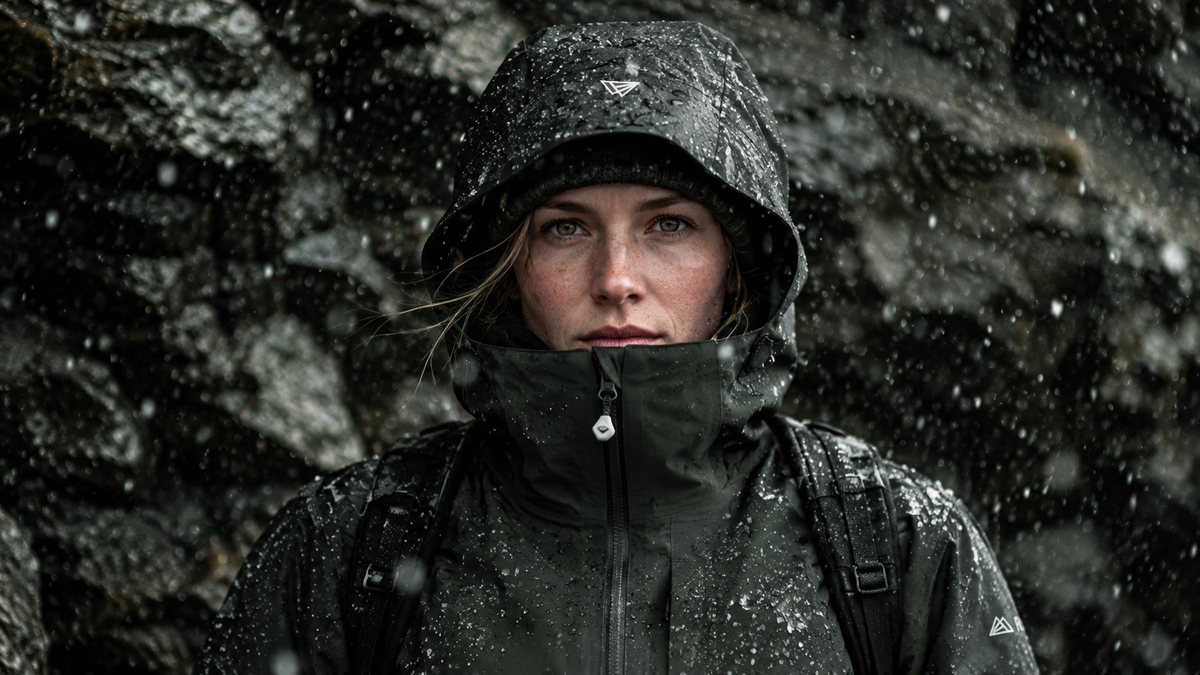
The weather app shows a few clouds. Yet the horizon is getting darker and darker. Is the softshell enough now, or does the hardshell belong in your backpack?
When buying outdoor clothing, you encounter terms such as waterproof, water-resistant and water-repellent. They sound similar, but they do not mean the same thing. Especially in prolonged rain, this difference can determine whether you stay dry or finish your trip in wet clothing.
We explain what these terms really mean, the role played by the hydrostatic head and when the R1 Hard Shell Layer or the R2 Soft Shell Layer is the right choice at RADYS.
Water-repellent and waterproof
These terms describe different levels of protection. What matters is not just the material but the entire construction of a garment.
Water-repellent
With a water-repellent material, water droplets initially bead off the surface. This is usually achieved through a treatment. It provides protection in drizzle, light snowfall and brief showers.
However, this effect is limited in duration. In prolonged or heavy rain, water can penetrate the outer fabric. Abrasion, dirt and frequent wear also reduce the beading effect over time.
Water-repellent materials are often especially breathable, stretchy and comfortable to wear. That is precisely where their strength lies.
Waterproof
Waterproof clothing is designed to keep you dry even in heavy or prolonged precipitation. This generally requires a waterproof membrane as well as appropriately finished seams and transitions.
A good hardshell keeps rain and wind out while allowing water vapour to escape from the inside to the outside. This protects you from external moisture without completely trapping the moisture produced during an ascent.
What does the hydrostatic head indicate?
The hydrostatic head indicates the water pressure a material can withstand before moisture penetrates it. It is measured in millimetres.
In principle, the higher the rating, the greater the protection against water pressure. This is caused not only by rain. A backpack strap, sitting on wet ground or strong wind can also exert additional pressure on the material.
The hydrostatic head is important, but it does not tell the whole story. For reliable protection from the elements, the seams, zippers, hood and closures must also be functionally designed.
At the same time, the highest rating is not automatically the best choice for every trip. In dry conditions, freedom of movement, air circulation and comfort can be more important than maximum protection from rain.
- 5,000 mm: sufficient for everyday use and light rain
- 10,000 mm: good protection in moderate rain and brief showers
- 15,000–20,000 mm: ideal for longer mountain tours and heavier rain
- 25,000 mm and more: suitable for extreme conditions (expeditions, ice climbing)

R1 Hard Shell Layer: When you need reliable weather protection
The RADYS R1 Hard Shell Layer is the outermost protective layer of the Modular Layering System. It is waterproof, windproof, breathable, and robust.
One example is the R1 Hiking Tech Jacket. Its three-layer R’Tech Hiking material consists of polyamide with a PU membrane. It achieves a water column rating of 20,000 millimeters and breathability of 40,000 g/m²/24h.
This means the jacket provides reliable protection from rain and wind, while water vapor can be transported outward. The R’Sonic construction also ensures flat, elastic, and durable fabric connections.
An R1 Layer is part of your equipment when:
- prolonged or heavier rain is possible
- you are traveling in exposed terrain
- snow, wind, or rapid weather changes are expected
- your tour lasts several hours or days
- reliable weather protection is more important than maximum breathability
Even if the sun is shining at the start, the lightweight hardshell can belong in your backpack as a safety reserve. Conditions often change faster than expected, especially in the mountains.
R2 Soft Shell Layer: For movement, comfort, and breathability
The RADYS R2 Soft Shell Layer takes a different approach. It is wind- and water-resistant, elastic, and designed for high levels of climate and movement comfort.
The RADYS R’Shell softshell fabrics are double-layer fabrics without an integrated membrane. This keeps air exchange particularly comfortable. Light precipitation initially beads off, but the R2 Layer is not a substitute for a waterproof hardshell in prolonged or heavy rain.
The R2 Hiking Softshell Jacket, for example, is made from an elastic R’Shell Hiking material and is 80 percent wind-resistant. The R2 Alpine Softshell Jacket also combines water- and wind-resistant materials with strategic ventilation and a temperature-regulating Merino-Knit-Lining.
An R2 Layer is particularly suitable when:
- conditions are predominantly dry
- you move intensely and generate a lot of body heat
- a brief shower or light snowfall is possible
- freedom of movement is particularly important
- you want protection from the wind without compromising high breathability
For hikes, fast ascents, and ski tours in stable conditions, the softshell is therefore often the more comfortable primary layer.
The best solution is often not R1 or R2, but R1 and R2
The RADYS Modular Layering System is designed so that the individual layers can be combined flexibly.
In dry conditions, wear the R2 Soft Shell Layer as a comfortable outer layer. If the rain gets heavier or the weather becomes unpredictable, put the R1 Hard Shell Layer on top.
This means you do not have to commit to one setup for the entire day in the morning. You can adapt your protection to the temperature, intensity and weather.
This is especially useful on longer mountain tours:
- During the ascent, R2 provides freedom of movement and comfortable air circulation.
- On a windy ridge, R2 provides additional protection against cooling down.
- When continuous rain sets in, R1 provides complete protection from the elements.
- During a break, you can add further insulating layers depending on the temperature.
Each layer has a clear purpose. Together, they create a flexible system that not only protects you but also reduces unnecessary sweating.

Three common misconceptions
1. Waterproof is always better
Not necessarily. A waterproof hardshell offers greater protection from precipitation, but during intense activity and in dry conditions it may feel less airy than a softshell. The best jacket is the one that suits the activity and the weather.
2. If water beads up, the jacket is waterproof
The beading effect primarily shows that the water-repellent treatment is working. Even a non-waterproof softshell material can initially repel water. Whether a garment is truly waterproof depends on its overall construction.
3. A high hydrostatic head is enough as a quality feature
The hydrostatic head measures the material under water pressure. In practice, however, breathability, seam construction, zippers, hood, fit and care are also crucial.
Proper care matters too
The water-repellent treatment is affected by dirt, sweat and friction. If water no longer beads up, the jacket is not necessarily leaking. The surface often just needs cleaning or the water-repellent treatment needs to be renewed.
Wash R1 and R2 products with a special membrane detergent, avoid fabric softener and always follow the care label. RADYS recommends air-drying hard- and softshell products, as well as regularly renewing the PFC-free water-repellent treatment.
The right protection for the right conditions
Waterproof and water-repellent are not competing levels of quality. They serve different purposes.
The R1 Hard Shell Layer provides reliable protection when rain, snow and wind leave no room for compromise. The R2 Soft Shell Layer comes into its own when freedom of movement, breathability and comfort are the priority.
Using both correctly does not simply mean maximum protection, but the right protection. That is precisely what RADYS' Modular Layering System is all about.


