

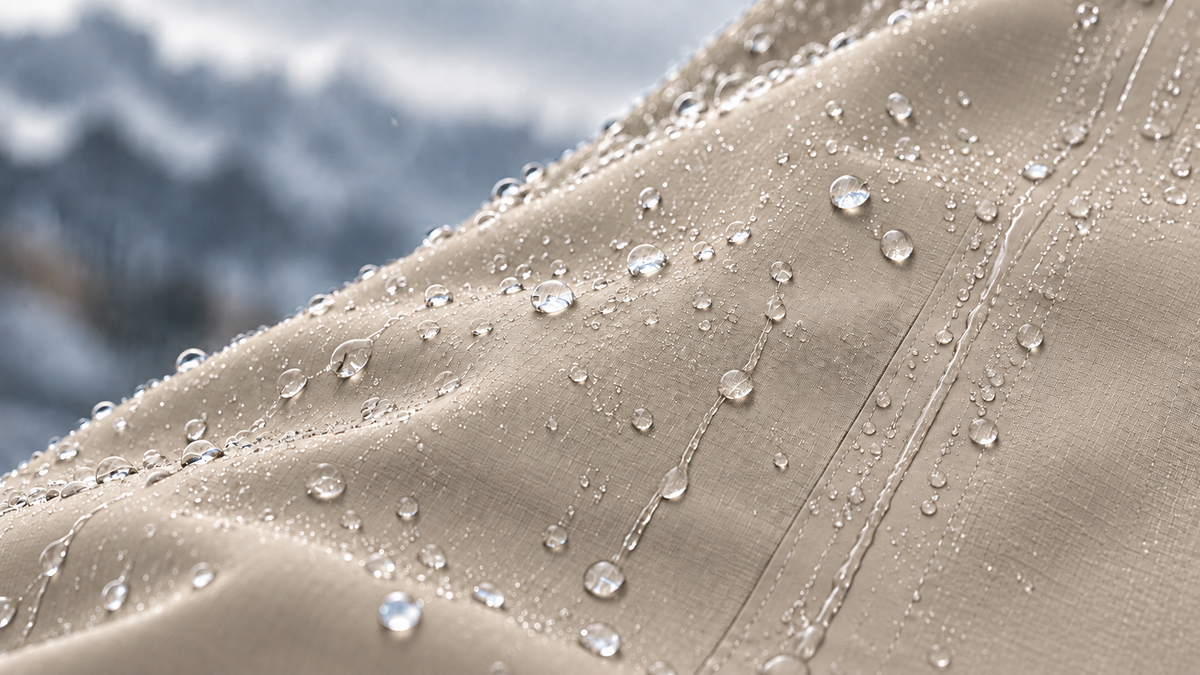
Rain rolls off. Snow does not stick. Dirt can simply be wiped away. For a long time, fluorinated chemicals were considered the ideal solution for permanently protecting outdoor clothing from water, oil, and dirt.
The problem: Many of these substances remain not only on the jacket for a long time, but also extremely long in the environment.
That is why terms such as PFC-free or PFAS-free are increasingly common on outdoor products today. But what do these abbreviations mean? Are PFC and PFAS the same thing? And can a Hardshell without these substances reliably protecting against rain at all?
We clarify the terminology and explain why RADYS switched to PFC-free water repellency at an early stage.
What are PFAS?
PFAS stands for per- and polyfluoroalkyl substances. It does not refer to a single chemical, but to a very large and diverse group of substances.
PFAS have been used for decades in numerous industrial processes and consumer goods. They can be found, for example, in certain coatings, food packaging, firefighting foams, pans, and textiles.
The reason for their widespread use lies in their special properties. Many PFAS are resistant to:
- Water
- Oil and grease
- Dirt
- Heat
- chemical influences
These properties are due, among other things, to very stable carbon-fluorine bonds. This very stability makes PFAS technically interesting and environmentally problematic.
What does PFC mean?
The term PFC was long used in the outdoor and textile industries as a collective term for fluorinated chemicals. This is why many products and older sources refer to PFC-free water-repellent finishes.
Today, the term PFAS is used more frequently. It is scientifically and regulatorily more precise and covers a large group of per- and polyfluoroalkyl substances.
In the context of outdoor clothing, the terms PFC-free and PFAS-free usually convey the same basic message: water-repellent performance is to be achieved without the problematic fluorinated chemicals.
Even so, it is worth taking a closer look. Some statements refer only to the impregnation of the outer fabric, while others refer to the membrane used or the entire product. Transparent information about the respective technology is therefore important.
Why were PFAS used in outdoor clothing?
In weatherproof clothing, fluorinated chemicals were used primarily for the durable water-repellent finish of the outer material. The abbreviation DWR is often used for this. It stands for Durable Water Repellent.
This treatment causes water to form droplets and roll off the surface. As a result, the outer fabric absorbs less water, stays lighter, and feels more comfortable.
The distinction is important: The treatment makes a Hardshell not waterproof on its own. The membrane, seam construction and the design of the garment are primarily responsible for actual waterproofness.
The treatment supports this function by preventing the outer fabric from becoming saturated with water too quickly.
Why are PFAS considered problematic?
The exceptional persistence of these substances has a downside. Many PFAS break down in nature little, if at all, or only very slowly. That is why they are often referred to as forever chemicals.
Once PFAS enter the environment, they can spread through water and soil. Some substances can also accumulate in humans, animals and food chains. Removing them from contaminated water or soil afterward is technically complex and expensive.
PFAS comprise a large group of substances, and not all of them have been studied equally well or assessed in the same way. However, negative effects on the environment and human health have been identified for several well-known representatives. For four particularly well-studied PFAS, the European Food Safety Authority considers a reduced immune response to vaccinations to be a critical health effect.
The fundamental problem remains regardless of individual substances: What does not break down for a very long time can spread through the environment over generations and remain there.
How do PFAS enter the environment?
The release can occur during various phases of the product life cycle:
-
during the manufacture of the chemicals
-
during the production and finishing of textiles
- through use, abrasion and washing
-
during disposal or incineration
-
through contaminated wastewater and production sites
The individual jacket is only one part of a much larger overall picture. PFAS are used in numerous applications. That is precisely why it is important to avoid fluorinated chemicals wherever effective alternatives are available.
Does PFC-free mean less weather protection?
No. A PFC-free treatment can still reliably repel water. However, it must be correctly matched to the material and regularly maintained.
We point out to be open about a small difference: A PFC-free treatment repels oil less effectively than a conventional fluorinated finish. For mountain sports clothing, this is hardly relevant in most situations. Protection from rain, snow and moisture is what matters.
With a hardshell, reliable weather protection is made up of several components anyway:
- a waterproof and breathable membrane
- functionally constructed seams
- matching zippers and finishes
- a water-repellent treatment of the outer fabric
- a well-designed hood and cut construction
PFC-free therefore does not automatically mean less performance. It means achieving the necessary functionality with a more responsible chemical solution.

The RADYS approach: PFC-free since 2014
We switchedn switched the entire collection to PFC-free water repellency as early as 2014. This made usn we among the early pioneers of the outdoor industry.
With the weather protection layers usewe a PFC-free treatment that makes water bead off without using problematic forever chemicals.
The principle behind this is clear: functionality and sustainability should not be played off against each other. A jacket must perform reliably in the mountains while also being designed to minimize its impact on the environment.
PFC-free clothing also needs care
Every water-repellent treatment loses effectiveness over time due to friction, dirt, and frequent use. This also applies to PFC-free treatments.
If water no longer beads off cleanly, this does not automatically mean that your jacket is leaking. It often first needs to be cleaned properly or reproofed.
Follow these basic rules:
- check the care label
- use a special detergent for technical clothing
- avoid fabric softener
- rinse out detergent residue thoroughly
- RADYS hard- and softshell products air-dried
- a PFC-free one when needed waterproofing spray use
Proper care preserves the product's functionality and extends its lifespan. This, too, is an important part of sustainable outdoor clothing.
Should I dispose of older outdoor clothing with fluorinated treatment?
You should not throw away a jacket that is still working properly too soon. In many cases, using, caring for, and repairing a product for as long as possible makes more sense than buying a new one immediately.
When you need to buy something new, look specifically for transparent information such as PFC-free treatment and a PFAS-free membrane. This supports technologies that can do without persistent fluorinated chemicals in the long term.
Responsibility starts with the material
PFAS have long made outdoor clothing more effective. However, their extreme persistence is also their greatest problem. What reliably repels rain, oil, and dirt does not simply disappear after use.
PFC-free treatments show that reliable weather protection is possible even without these forever chemicals. With the PFAS-free R’Tech With Nano Membrane, RADYS goes one step further, combining innovative membrane technology with a consistent commitment to the environment.
Because true performance is not only about how well a product works today. It is also about the traces it leaves behind tomorrow.


